Part Two of The Three C’s of Dog Training Series
In Part One of this series, we introduced the three values that have become the foundation of everything we do at The EveryDay K9:
Consistency. Communication. Collaboration.
Now I want to pull those apart.
And we're starting with communication because, in many ways, communication is dog training.
I say this all the time:
“We’re really a communications company disguised as a dog training company.”
It usually gets a laugh.
But I genuinely mean it.
When someone calls us because their dog is pulling on the leash, jumping on guests, reacting toward other dogs, ignoring commands, guarding something, or struggling with anxiety, they understandably see the behavior as the problem.
As trainers, we're looking deeper.
What is the dog communicating?
And equally important:
What has the human been communicating back?
Sometimes those two sides have been having completely different conversations for years.
Your Dog Has Been Talking to You This Entire Time
Dogs don't communicate the way we do.
They can't sit you down and explain that they're uncomfortable.
They can't tell you that the dog walking toward them is making them nervous.
They can't explain that the house has become too exciting and they're overstimulated.
They can't tell you that they don't understand what you're asking.
So they communicate differently.
Their ears change.
Their mouth changes.
Their eyes change.
Their body becomes softer or stiffer.
Their weight shifts.
They create distance.
They stare.
They avoid.
They lick their lips.
They pace.
They bark.
They growl.
Sometimes, eventually, they bite.
One of the most important things we teach owners is that the bark, growl, lunge, or bite is rarely the beginning of the conversation.
It may be the point where the human finally noticed it.
That's a very important distinction.
When you begin learning your dog's body language, you start noticing the quieter conversations that happen before the big ones.
And suddenly you aren't simply reacting to your dog's behavior anymore.
You're beginning to understand it.
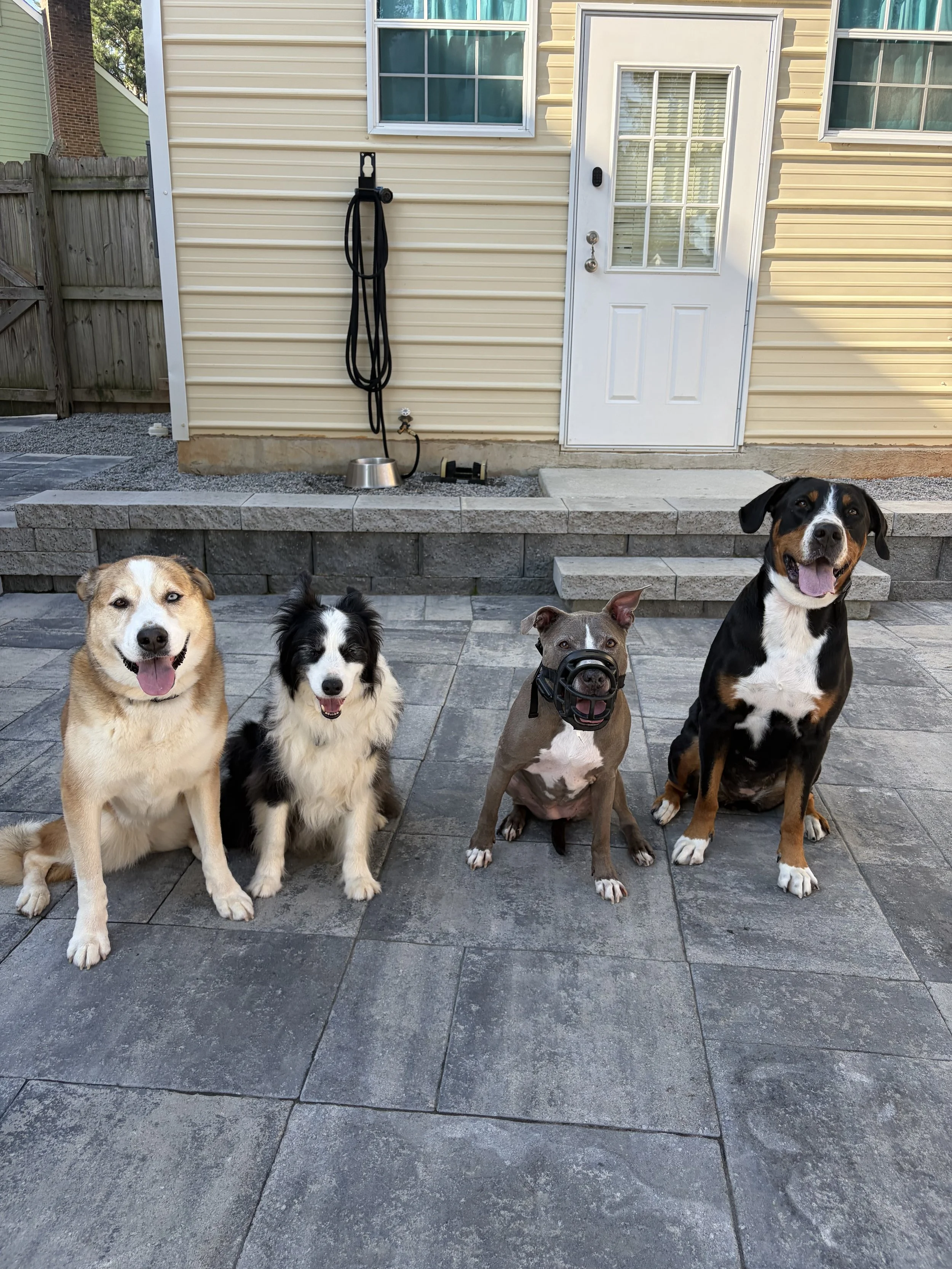
But Communication Goes Both Ways
Here's where dog training gets really interesting.
While you're trying to read your dog...
Your dog is constantly reading you.
Your body language.
Your tone.
Your timing.
Your tension.
Your movement.
Your confidence.
Your hesitation.
Your energy.
We've written before about how much human energy can influence dogs, and this is exactly where that becomes part of communication.
Think about something as simple as a leash.
Your dog sees another dog approaching.
You become nervous because you know what normally happens next.
Without realizing it, you shorten the leash.
Your body becomes tense.
Maybe you stop breathing normally.
Maybe you start repeating:
“Leave it.”
“Leave it.”
“Leave it.”
“No.”
“Come on.”
“Be good.”
Before the other dog has even reached you, you've communicated quite a lot.
Then your dog reacts.
And we say:
“See! He hates other dogs.”
Maybe.
But maybe there's more happening.
This is why dog psychology matters.
And it's why good dog training cannot simply be about teaching commands.
A Command Is Only Valuable If Both Sides Understand It
“Sit.”
“Down.”
“Place.”
“Heel.”
“Come.”
“Break.”
To us, these are words.
To a dog, initially, they're meaningless sounds.
Training gives those sounds meaning.
That's communication.
If I say “place” and I've properly taught my dog what place means, we've created a shared piece of language.
But here's where people sometimes struggle.
They change the language constantly.
“Come.”
“Come here.”
“Come on.”
“Get over here.”
“I said COME.”
To the human, all of those sentences mean roughly the same thing.
To the dog, we've potentially changed the picture five times.
Then we become frustrated because the dog isn't listening.
This is one of the reasons timing and consistency are so important in training.
We want to make communication as black and white as reasonably possible.
This is what I'm asking.
This is what I want you to do.
Yes, that's correct.
No, that's not what I'm asking. Try again.
And then:
Good. That's exactly it.
That clarity is incredibly powerful for a dog.
Rewards and Corrections Are Communication, Too
This is an important part of our philosophy as balanced dog trainers.
Communication isn't only telling a dog when they've made the right choice.
It's also being able to communicate when they've made the wrong one.
Rewards have meaning.
Corrections have meaning.
Leash pressure has meaning.
Releasing pressure has meaning.
Praise has meaning.
Food can have meaning.
Freedom can be a reward.
Even withholding attention can communicate something.
But none of those things are particularly useful if the dog doesn't understand why they're happening.
That's where timing becomes everything.
If you're rewarding something several seconds after it happened, what exactly does the dog believe you're rewarding?
If you're providing a correction but the dog has no understanding of what they should have done instead, what have they actually learned?
Our goal isn't simply to reward or correct behavior.
Our goal is understanding.
The clearer the communication becomes, the less confusion exists between dog and owner.
Sometimes the Most Powerful Communication Is Saying Nothing
This is one of my favorite examples to give owners.
When our trainers meet a dog, particularly an overly excited dog, we often don't immediately:
Make eye contact.
Talk to them.
Reach down.
Pet them.
Get them excited.
Why?
Because all of those things communicate something.
Imagine an excited dog jumping all over someone.
The person looks at them.
“Oh my gosh! Hiiiiii!”
They reach down.
They pet the dog.
The dog jumps higher.
“Down! Down! Stop jumping!”
But they're still touching them.
Think about that conversation from the dog's perspective.
The human's words are saying one thing.
Everything else they're doing may be saying another.
We would rather communicate clearly from the beginning.
You can exist around me without immediately receiving my attention.
Four paws can stay on the ground.
You can settle.
Then interaction can happen.
That's a boundary.
And contrary to the way boundaries are sometimes portrayed, boundaries aren't about having a miserable dog that isn't allowed to do anything.
Boundaries create clarity.
Dogs thrive when they understand what is expected of them.
This Is Where Human Education Becomes So Important
We can teach a dog all day long.
But eventually...
That dog goes home.
This is where I think the dog training industry sometimes misses an enormous piece of the puzzle.
You cannot adequately train the dog without educating the human.
That's why our go-home lessons are so important to us.
It's why we spend so much time talking instead of simply handing someone a leash and demonstrating commands.
It's why we explain dog psychology.
It's why we discuss body language.
It's why we explain what happens when something goes wrong.
It's why we teach owners how to adjust.
And it's why we've spent hundreds of hours developing and continually improving our online educational modules.
We want owners to have information they can return to after the lesson is over.
Because we don't expect you to remember everything we teach you in one afternoon.
And we don't believe education should stop when the formal training program ends.
Even professional guidance on selecting a trainer emphasizes the importance of the trainer being a good teacher—someone who can explain what they're training, why it matters, demonstrate it, and adapt to the individual dog.
I couldn't agree more with the importance of that educational component.
The owner has to understand the training.
Otherwise we've trained a dog without building the communication system necessary to maintain it.
You Have to Learn to Read the Whole Dog
One thing I really want people to take away from this blog is that dog communication isn't a checklist.
A wagging tail doesn't automatically mean happy.
A growl doesn't automatically mean aggressive.
Panting doesn't automatically mean hot.
One behavior without context can tell an incomplete story.
You have to look at the dog in front of you.
What happened immediately before the behavior?
What does the rest of their body look like?
What environment are they in?
Is this normal for this particular dog?
What happened five minutes ago?
What is the human doing?
Context matters.
Veterinary behavior resources make this same point: canine communication involves multiple signals, and understanding the whole dog gives us a much better picture than relying on one isolated behavior.
And this is where experience becomes incredibly valuable.
After you've worked with thousands of dogs, you start noticing the smaller details.
The things that are easy to miss when you're only looking at the obvious behavior.
That doesn't mean we know everything.
Far from it.
Dogs are constantly teaching us.
But it does mean experience gives us a much larger library of behavior to compare what we're seeing against.
Communication Happens Behind the Scenes at The EveryDay K9, Too
Communication is one of our core values because it doesn't stop with training.
It's something we expect internally from our entire team.
If your dog is boarding with us and has loose stool...
We communicate it.
If your dog isn't eating normally...
We communicate it.
Medication?
Communicate it.
A change in behavior?
Communicate it.
A limp?
Communicate it.
Something that just seems slightly “off?”
Communicate it.
We would rather our team communicate too much than assume someone else noticed something.
That same philosophy applies to how we communicate with our clients.
Our services are intentionally hands-on.
Whether we're training your dog, boarding them, walking them, or caring for them in another capacity, you're trusting us with a member of your family.
That deserves exceptional communication.
Ultimately, We're Teaching Two Different Species How to Understand Each Other
That's what fascinates me most about dog training.
You have two completely different species living under the same roof.
We expect them to understand our homes.
Our schedules.
Our social expectations.
Our rules.
Our language.
Our families.
Our world.
And yet, sometimes we spend very little time learning theirs.
Dog training bridges that gap.
We teach the dog how to navigate the human world.
But equally importantly...
We teach the human how to understand the dog.
That's communication.
And when that communication becomes clearer, something really special happens.
Owners become more confident.
Dogs become more confident.
Frustration decreases.
Expectations become clearer.
Boundaries make more sense.
And the relationship begins to change.
That's why we're a communications company disguised as a dog training company.
Because we're not interested in simply creating dogs that know commands.
We want to create humans who understand their dogs.
And communication is where that starts.
Next in The Three C's of Dog Training Series: Consistency.
Because understanding what to do is one thing.
Doing it tomorrow...
Next week...
And six months from now?
That's where things get interesting.
And as we continue through this series, we're building toward something we've been working on behind the scenes at The EveryDay K9—something centered around education, connection, and making sure the relationship with our clients doesn't simply end when training does.
We're not quite ready to share it yet.
But we think you're going to understand exactly why we're building it by the time we reach the end of this series.
Stay tuned.